SIR RICHARD BRANSON: THE MASTER OF PERSONAL BRANDING
Sir Richard Branson’s personal brand is the epitome of a good brand story. It showcases the triumph of an underdog over entrenched business interests. By choreographing outlandish publicity stunts, Branson injects humour and lightheartedness into this narrative, thereby making it more appealing to the general public. However, the biggest threat to Branson’s story is the growing perception that he is no longer an underdog. Indeed, many claim that he has become one of the fat cats he once nobly crusaded against. In other words, Branson may be a victim of his own success.
What is Richard Branson’s Brand Story?
Branson was born in London to a prominent legal family. In his early years, he struggled academically as he suffered from dyslexia (Branson, 1999). At the age of 16, he founded his first successful venture: Student Magazine (ibid).

Branson funnelled the profits from his magazine into a record shop and a recording studio, thereby creating Virgin Records (Biography.com Editors, 2019). The cheekiness of this name was avant-garde at the time, and embodied the counter-cultural spirit of the brand.

Virgin Records audaciously signed controversial bands, such as the Sex Pistols, who other labels shied away from (ibid). This risky strategy paid off, and Virgin Records went on to become the largest independent record label worldwide (Entrepreneur, 2008). This tremendous success was achieved due to Branson’s willingness to buck commercial norms.

Branson continued his success by disrupting the airline industries in Australia and around the world (Zeveloff, 2011). Yet many of Branson’s ventures flopped, and by 1992, his airline was on the brink of insolvency (Biography.com Editors, 2019). While Virgin has since rebounded, Branson’s notable failures impart relatability and a touch of humanity to his personal brand.

In recent years, Branson has turned his attention to the space tourism (Zeveloff, 2011) and hyper loop transportation (Jenkins, 2017) industries. This adds to the public perception of Branson as a visionary and innovator.


Branson’s life story is analogous to the parable of David and Goliath (Schurenberg, 2013). He went from a dyslexic high school dropout to multi-billionaire. And he pulled it off by saving consumers money and making them smile.

Why Does Richard Branson’s Brand Story Resonate?
One may view Branson’s personal brand through the lens of Keller’s Customer-Based Brand Equity Model (2012).

Branson creates brand salience by doing business across a vast array of industries. In doing so, Branson develops a broad awareness of his personal brand across various demographics. Virgin has 97% brand recognition in Australia (Virgin 2019), and as the face of the brand, Branson is likely not far behind.
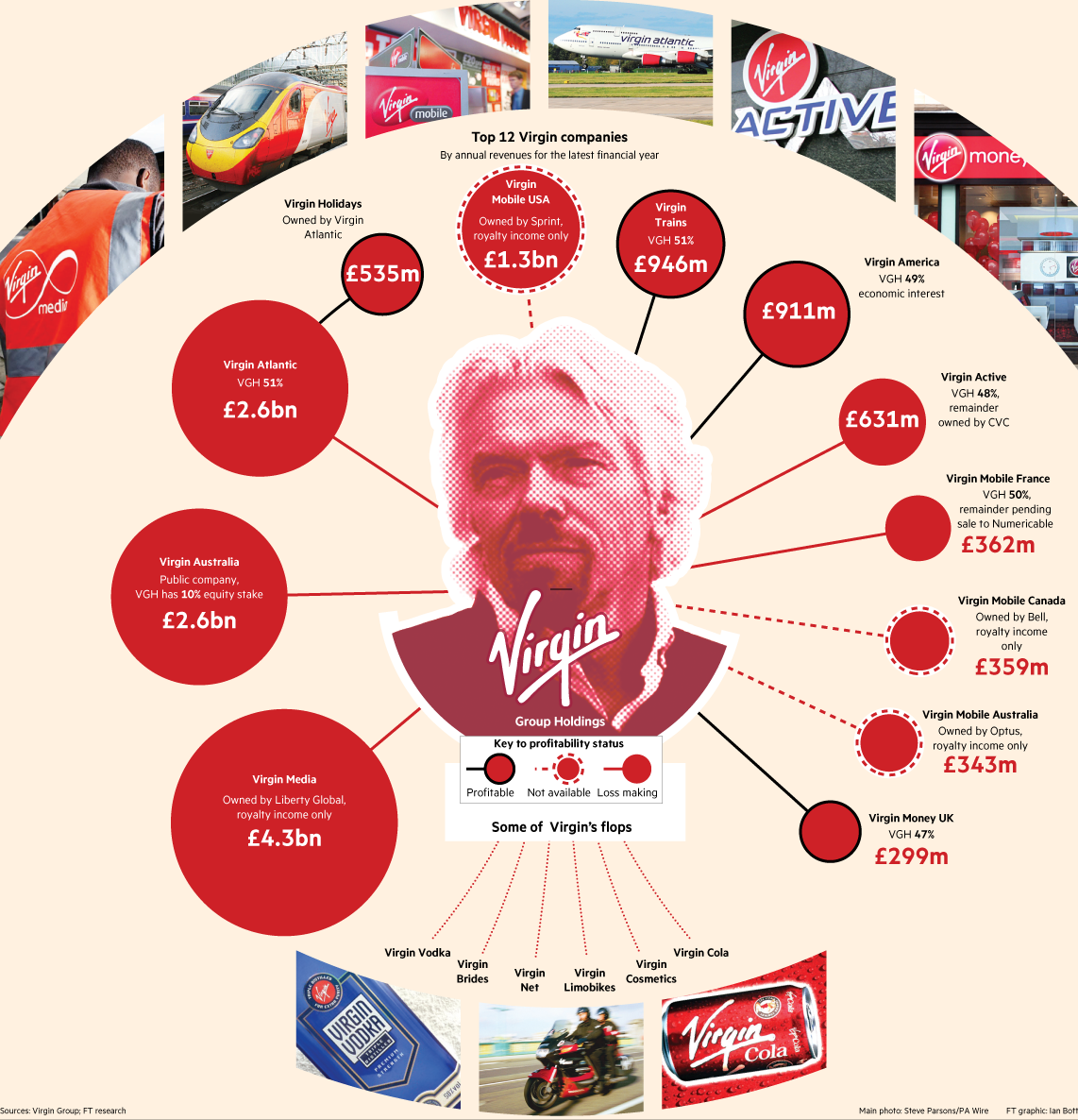
Branson creates brand meaning by communicating performance and imagery. Branson performs through entering noncompetitive industries and undercutting established players without compromising quality (Kiss, 2007).
Equally important is the image that Branson presents to the world. He maintains a peculiarly dishevelled appearance for a billionaire, and is always photographed grinning. This evinces a point of difference with respect to the stereotype of the snobby, clean-cut corporate “suit”.

Branson is the master of eliciting positive responses to his personal brand. He does this through coordinating elaborate publicity stunts. These stunts evoke feelings of warmth, fun and excitement in onlookers. The media broadcasts Branson’s stunts widely, as they are beloved by the masses. Branson skilfully leverages the media to generate favourable coverage of his personal brand.

Branson’s personal brand resonates with consumers by driving active engagement. For example, Branson is the most followed professional on LinkedIn (Reed, 2017). He is not courting consumers, rather they are courting him. Note that Branson’s personal LinkedIn page has over 100 times the followers than any Virgin page (Reed, 2017). Therefore, Branson’s personal brand eclipses that of Virgin. Virgin is merely an agent which transforms Branson’s personal brand into tangible products and services.
Branson’s LinkedIn Page: https://www.linkedin.com/in/rbranson
Customers feel an attitudinal attachment to Branson’s personal brand, and by extension, Virgin. This enables Branson to charge businesses around the world top dollar for the license to use the Virgin brand name (Gordon, 2014). This is yet another testament to the resonance of Branson’s personal brand with consumers.
Additionally, the appeal of Branson’s personal brand may be understood through Aaker’s Brand Personality Framework (1997, p. 352). The brand embodies sincerity and excitement, but also incorporates elements of competence, sophistication and ruggedness.

Is Richard Branson Becoming a Victim of His Own Success?
While Branson has been a media darling for decades, his swashbuckling persona has recently come under fire. Critics allege that Branson is inauthentic. A few weeks ago, Branson posted a photo of himself playing chess to his blog, while proclaiming his love for the game (Watson, 2019). Detractors gleefully announced that Branson had set up the board incorrectly (ibid).
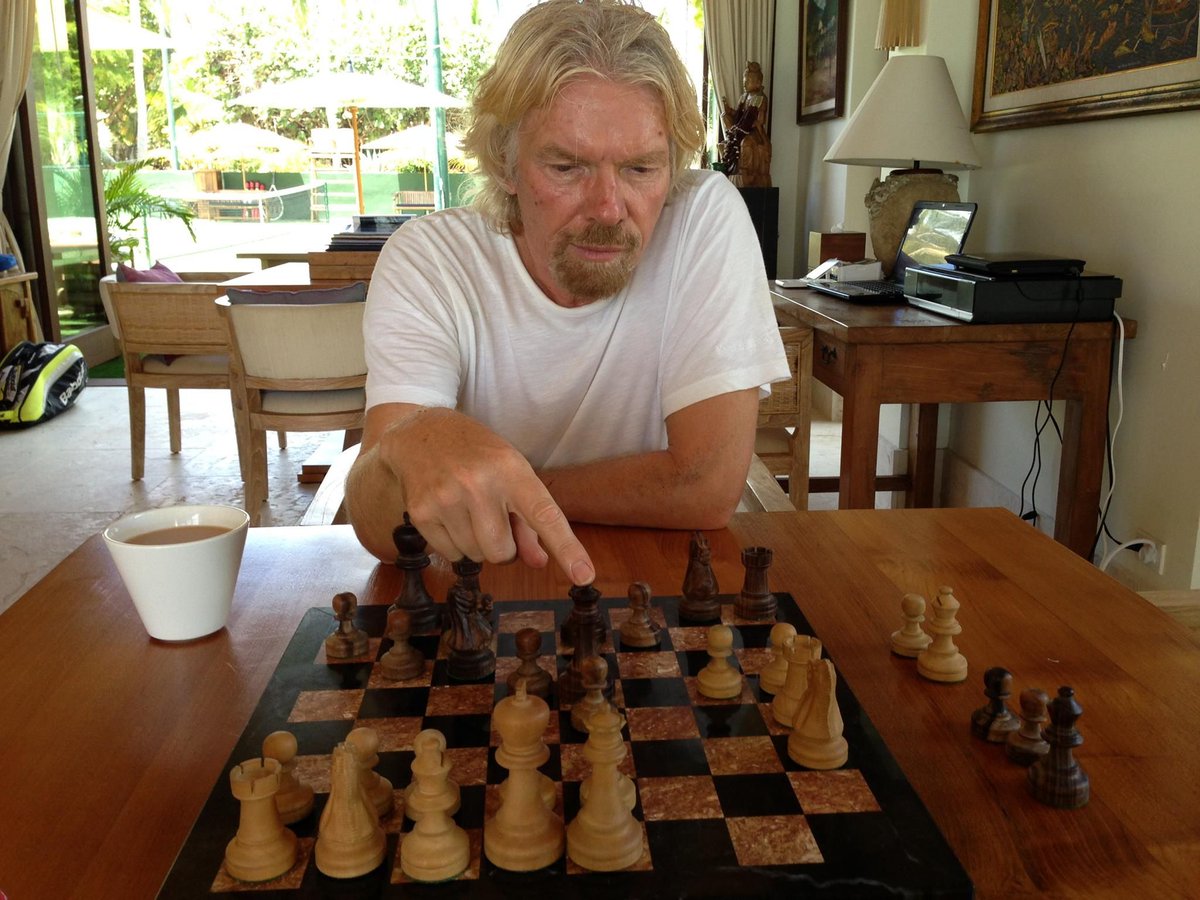
Branson is a vocal climate change advocate (Boje and Smith, 2010: p. 26), but does not shy away from private jet travel (Moore, 2014). Despite preaching that responsibility comes with wealth (ibid), he resides in a tax haven (Metcalf and Stupples, 2019). His penchant for using women as props in his stunts (Moore, 2014) is anachronistic in the #MeToo era. Branson is mutating into an unscrupulous business magnate, just without the necktie.



If the public embraces these criticisms, Branson’s personal brand is jeopardised, and with it the Virgin empire. At a time of soaring wealth inequality, public relations management for billionaires has never been more difficult.

Yet Branson has faced countless challenges in the past, and assiduously bounced back. So history is on his side. But all good things must come to an end, and one day Branson’s magnetic personal brand will fade into obscurity.

Reference List:
Aaker, J. L. (1997). Dimensions of Brand Personality. Journal of Marketing Research, 34(3), pp.347-356.
Biography.com Editors (2019). Richard Branson Biography. [online] The Biography.com website. Available at: https://www.biography.com/people/richard-branson-9224520 [Accessed 24 Mar. 2019].
Boje, D. and Smith, R. (2010). Re‐storying and visualizing the changing entrepreneurial identities of Bill Gates and Richard Branson. Culture and Organization, 16(4), pp.307-331.
Branson, R. (1999). Losing My Virginity: How I’ve Survived, Had Fun, and Made a Fortune Doing Business My Way. New York: Crown Business.
Entrepreneur. (2008). Richard Branson: the PT Barnum of British Business. [online] Available at: https://www.entrepreneur.com/article/197616 [Accessed 24 Mar. 2019].
Gordon, S. (2014). Virgin group: Brand it like Branson | Financial Times. [online] ft.com. Available at: https://www.ft.com/content/4d4fb05e-64cd-11e4-bb43-00144feabdc0 [Accessed 17 Mar. 2019].
Jenkins, A. (2017). http://fortune.com. [online] Fortune. Available at: http://fortune.com/2017/10/12/hyperloop-one-virgin-group-richard-branson/ [Accessed 24 Mar. 2019].
Keller, K. L. (2012). Strategic Brand Management. 4th ed. Boston: Pearson.
Kiss, J. (2007). Virgin Media sports package to undercut Sky. [online] the Guardian. Available at: https://www.theguardian.com/media/2007/feb/15/bskyb.broadcasting [Accessed 24 Mar. 2019].
Metcalf, T. and Stupples, B. (2019). Bloomberg – Are you a robot?. [online] Bloomberg.com. Available at: https://www.bloomberg.com/news/articles/2019-02-20/billionaire-brexiteer-leads-ranks-of-u-k-s-footloose-fortunes [Accessed 24 Mar. 2019].
Moore, S. (2014). Branson: Behind the Mask by Tom Bower – review. [online] the Guardian. Available at: https://www.theguardian.com/books/2014/feb/12/branson-behind-mask-tom-bower-review [Accessed 24 Mar. 2019].
Oxfam International (2015). Wealth: Having It All and Wanting More. [online] Oxfam International. Available at: https://www.oxfam.org/en/pressroom/pressreleases/2015-01-19/richest-1-will-own-more-all-rest-2016 [Accessed 24 Mar. 2019].
Reed, C. J. (2017). Richard Branson’s Personal Brand is 100x more powerful than the Virgin brand – here’s why. [online] Linkedin.com. Available at: https://www.linkedin.com/pulse/richard-bransons-personal-brand-100x-more-powerful-chris-j-rock-star [Accessed 16 Mar. 2019].
Schurenberg, E. (2013). “It’s a lot more fun being David than Goliath.”. [online] Inc.com. Available at: https://www.inc.com/eric-schurenberg/sir-richard-branson-its-a-lot-more-fun-being-david-than-goliath.html [Accessed 24 Mar. 2019].
Virgin. (2019). Our Strategy. [online] Available at: https://www.virgin.com/virgingroup/content/our-strategy [Accessed 17 Mar. 2019].
Watson, L. (2019). Richard Branson mocked for bragging about chess – while playing with the board the wrong way. [online] The Telegraph. Available at: https://www.telegraph.co.uk/news/2019/03/01/chairman-board-not-quite-sir-richard-branson/ [Accessed 24 Mar. 2019].
Zeveloff, J. (2011). RICHARD BRANSON: How A Canceled Flight Led To The World’s Greatest Travel Empire. [online] Business Insider Australia. Available at: https://www.businessinsider.com.au/richard-branson-entrepreneur-visionary-2011-5/?r=US&IR=T [Accessed 24 Mar. 2019].

 ONA Coffee