
Freddo Frog is an anthropomorphic cartoon frog owned by the parent brand Cadbury. Freddo is a venerable marketing device in Australia, first conceived in 1930 and surviving to this very day.

Being 89 years old, Freddo Frog has withstood the test of time. This is because Freddo Frog continues to add brand equity to Cadbudy. But how can this claim be supported? In the spirit of evidence-based marketing (Lewis, 2018), the writer proposes that numbers be crunched.
A crude, yet effective, metric to quantify brand equity is the consumer’s willingness to pay a price premium (Netemeyer, 2004: p. 210). By investigating consumers’ willingness to pay for Freddo Frogs, one may approximate the brand equity contributed to Cadbury by Freddo Frog.
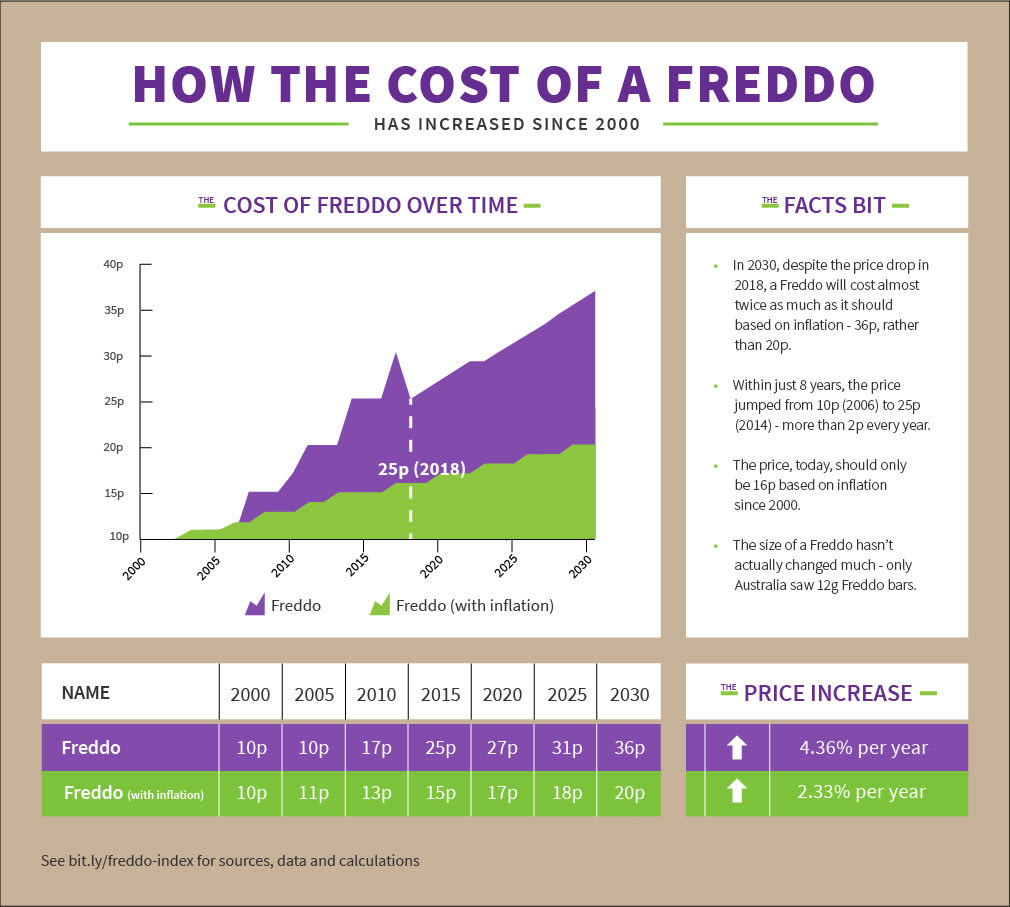
The graphic below demonstrates that the price of Freddo Frog branded chocolate has markedly outpaced inflation over the past decade (note: this data was collected from the UK market). This implies that consumers are willing to tolerate price increases for Freddo Frog chocolate to a greater extent that the average product. Furthermore, this trend is projected to continue over the next decade.
However, in the interests methodological soundness, the brand equity generated by Freddo Frog should be ascertained with respect to competing brands in the confectionery industry.
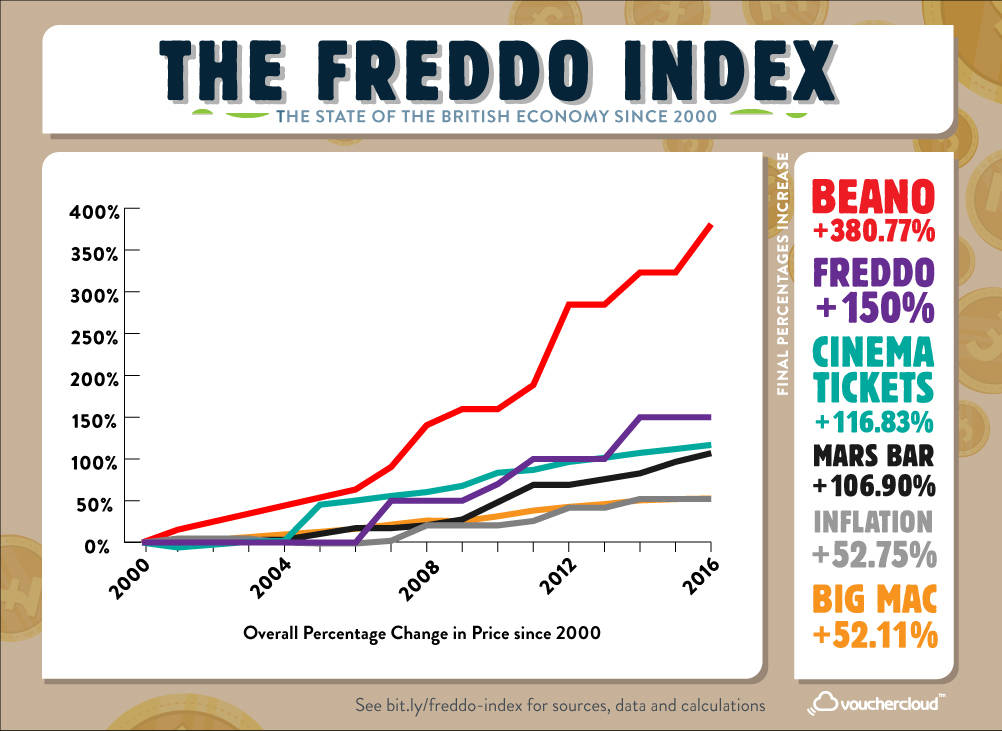
The graphic below demonstrates that the price of Freddo Frog chocolate has not only outpaced inflation, but also the competing product Mars bars by 43.1%. Plausibly, the brand equity created by Freddo Frog character is responsible, at least in part, for the superior market power the frog enjoys relative to its competitor.
In Australia, Freddo Frogs have similarly increased in price over the past few years (Watkins, 2017). However, the Australian Freddo Frogs have decreased in net weight by almost half (ibid). Therefore, the price of Freddo Frogs per gram has more than doubled in this period.
The Freddo Frog character clearly enhances the ability for Cadbury to charge more for its chocolate, both domestically and overseas. But how?
Simple designs have been proven to be effective for other cartoon brand agents (Hosany et al, 2013: p. 52; 56). Freddo has a simple design, and has no “lore” or “world-building” supporting his character. There is no backstory that consumers need be cognisant of for him to be appealing. Due to Freddo Frog’s simplicity, it is difficult for competitors to field counterfeits.
Further, Freddo Frog capitalises on nostalgia of consumers (Watkins, 2017). Particular items in one’s life may evoke a formidable sense of the past (Belk, 1991). In my personal experience, I have many fond memories being treated to and rewarded with Freddo Frogs. As such, I continue to purchase the frogs today, especially if I am feeling blue.
Going forward, the brand equity generated by Freddo Frog may become less potent. The medical community is harshly critical of the use of cartoon media characters to market unhealthy foods to children. In their eyes, this is a contributing factor to the obesity epidemic (Kraak and Story, 2014)). Yet as it stands today, Freddo Frog’s magnetic allure is rewarding Cadbury’s shareholders handsomely.
References:
Belk, R. (1991). Highways and Buyways. Provo, UT: Association for Consumer Research.
Hosany, S., Prayag, G., Martin, D. and Lee, W. (2013). Theory and strategies of anthropomorphic brand characters from Peter Rabbit, Mickey Mouse, and Ronald McDonald, to Hello Kitty. Journal of Marketing Management, 29(1-2), pp.48-68.
Invitation Ltd. (2018). The Freddo Index – The History of Freddo Prices Since 2000. [online] vouchercloud. Available at: https://www.vouchercloud.com/resources/the-freddo-index [Accessed 27 Mar. 2019].
Kraak, V. and Story, M. (2014). Influence of food companies’ brand mascots and entertainment companies’ cartoon media characters on children’s diet and health: a systematic review and research needs. Obesity Reviews, 16(2), pp.107-126.
Lewis, C. (2018). We need evidence-based marketing to save us from the fads and fashions. [online] Marketing Week. Available at: https://www.marketingweek.com/2018/05/09/colin-lewis-evidence-based-marketing/ [Accessed 27 Mar. 2019].
Netemeyer, R., Krishnan, B., Pullig, C., Wang, G., Yagci, M., Dean, D., Ricks, J. and Wirth, F. (2004). Developing and validating measures of facets of customer-based brand equity. Journal of Business Research, 57(2), pp.209-224.
Watkins, J. (2017). How Australia’s Willy Wonka Created Britain’s Most Controversial Candy. [online] OZY. Available at: https://www.ozy.com/flashback/how-australias-willy-wonka-created-britains-most-controversial-candy/81844 [Accessed 27 Mar. 2019].

 ONA Coffee